

Huge differences reported in yields
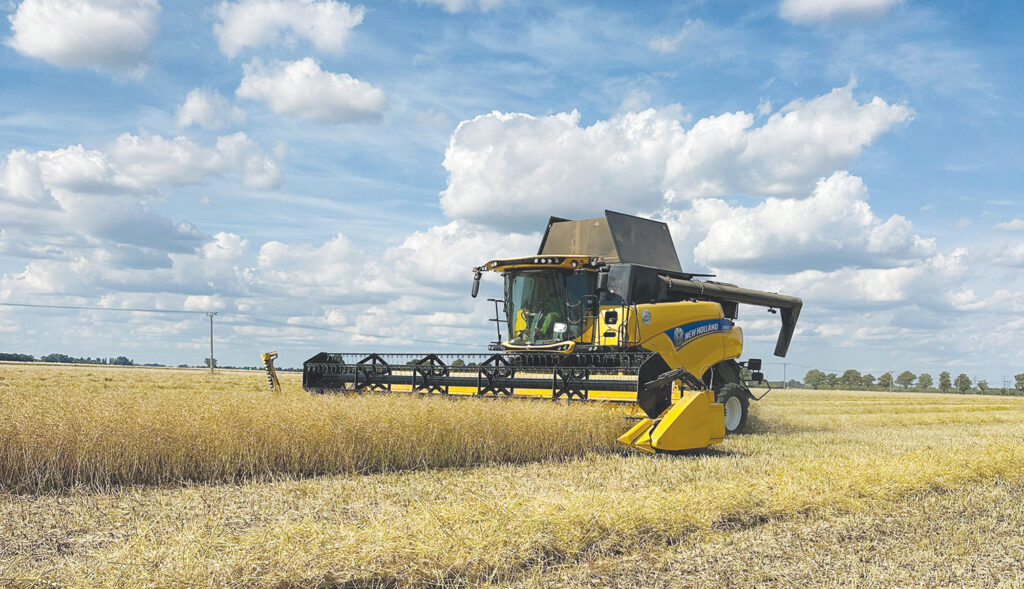
Early yields this harvest are better than expected on some farms – but other crops coming off the field are disappointing.
After a rollercoaster growing season marked by prolonged drought followed by sudden downpours, combine harvesters rolled into barley crops in late June – a fortnight earlier than usual for many farmers.
Yield results
Some 10% of the UK winter barley area was harvested by 9 July, suggests the Agriculture and Horticulture Development Board. This compares with 7% at the same time last year and a five-year average of 6% complete.
Early-cut winter barley and oilseed rape have yielded reasonably well in places – despite blistering heat and near-total lack of rain during May and June – offering a glimmer of hope after a season that tested nerves and stretched resources.
But that hope is tempered by significant inconsistencies.
While some growers report winter barley yielding above the five-year average at 9t/ha, it’s a very different story for others seeing less than 5t/ha on lighter land – with crops typically performing better on heavier clays than on sandier soils.
Oilseed rape
It’s a similar story for winter wheat. But winter oilseed rape appears to be faring surprisingly well, with United Oilseeds reporting yields of 5t/ha for Pinnacle and 4.5t/ha for Aurelia and Dolphin harvested in mid-July.
Cambridgeshire grower Philip Allen saw a crop of Pinnacle yield 4.38t/ha at 9% moisture. “The seed is very big with a nice and shiny black look,” he said. “Interestingly there are no adult cabbage stem flea beetles in the trailers, just lots of ladybirds.”
The biggest challenge for many growers came last month when rain finally arrived but in the form of torrential downpours.
With combines confined to barracks for days on end, farmers went from praying for rain to fearing what would happen next.
Varietal importance
Agronomists point to improved genetics and targeted agronomy as crucial in getting crops over the line – a reminder of how much resilience is now bred into modern varieties in a big to combat climate extremes.
Grain quality is another mixed bag. Hagbergs and proteins in milling wheat have held up, but concerns are rising about sprouting in crops yet to be harvested – and that accounts for the majority on many farms.
Looking ahead, many growers say 2025 will be remembered not as an overall disaster or a success, but for its contrasts. With adjacent fields performing very differently, this harvest is one of extremes rather than one of averages.
Credit offered if crops fail
Growers will be offered a credit of £100 per bag of seed from Bayer for oilseed rape establishment failures this autumn.
The Dekalb Establishment Scheme for 2025 covers high-performance hybrid oilseed rape varieties DK Excentric,DK Extremus, DK Excited, DK Exstar and clubroot-resistant DMH585.
Bayer campaign manager Richard Phillips says: “Should cabbage stem flea beetle or other oilseed rape crop establishment pressures prove too much this autumn, we will be on hand to help.”
Scheme rules
Under the scheme, growers can claim for total establishment failure of blocks of 6ha or more – either as whole fields or as single uninterrupted blocks within larger fields.
Registration is simple to do and free of charge, says Mr Phillips. The rules of engagement state that seed must be purchased through a participating seed supplier and crops sown – using normal good practice – before 20 September 2025.
The closing date for registration is 30 September and claim forms must be completed and submitted via the seed supplier by 31 October. For full details, growers should speak with their seed supplier when purchasing seed.
For those growing an eligible variety, joining the Dekalb Establishment Scheme is a no-brainer, says United Oilseeds seed manager Beckii Gibbs.
“Why wouldn’t you join? You have nothing to lose from taking advantage of the scheme; it’s without doubt a useful tool in managing the risk of oilseed rape establishment failure and it can add a little bit of a confidence boost.”
Growers of specialist HOLL oil variety V367OL should contact their supplier directly for information on the parallel HOLL-specific Establishment Scheme. Claims made under this scheme must be submitted by 15 September 2025.


Industry leaders aim to secure profitable future
News Apr 1, 2026
New law on dog attacks comes into effect
News Mar 4, 2026


Revealed: Latest details for revamped SFI scheme
News Mar 4, 2026