

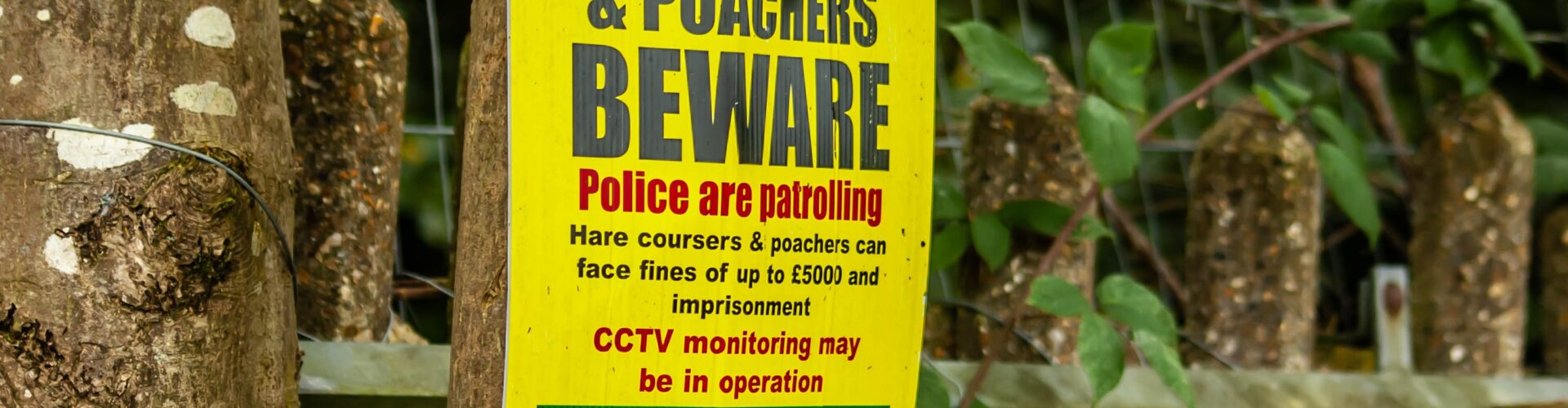
 Autumn fields are ideal for hare-coursing – and each year sees a surge in incidents as the landscape opens up after harvest. It’s a tough time – especially for farms which are repeatedly targeted by coursers. While eliminating the problem can be difficult, practical steps can be taken to reduce the likelihood of fields being used for this illegal “sport”.
This isn’t about a single fence or a single padlock. It’s about building layers of resistance that turn your land from an easy target into a hard one. Hare-coursers, like most opportunists, move on when the target is harder to exploit. Almost all hare-coursers depend on a vehicle: they use it to reach the field, and then to drive across it once the dogs are slipped. Take the vehicle out of the equation, and you take the crime out of your farm.
Start with the perimeter, not the gate
The boundary between a public road or green lane and your field is where the battle is won or lost. A consistent, well-maintained hedge or closely planted trees; a raised verge or high curb, robust engineered fencing; or a substantial ditch, swale, or roadside dyke that no road-going vehicle can cross – these are your first and best line of defence. Walk your boundaries with a courser’s eye and ask: where would I get a car onto this field? At the obvious pinch points – junctions where a road or lane runs straight at a field entrance – an Armco-style crash barrier works well, providing road safety while physically denying access to your land. And if you’re planning ditch works, look at bringing them into an SFI scheme or field margin herbal lay. It’s a rare case where good countryside stewardship and crime reduction measures are compatible.
Why causing a delay can pay
Every gateway you leave available is an invitation. Reduce them to the genuine minimum your operation needs, then treat what remains as proper security infrastructure rather than standard farm ironmongery.
The livestock gate that’s fine for keeping sheep in is nowhere near good enough here. Protect the hinge end so the gate can’t simply be lifted off. On the locking end, use two or more separate locking points rather than one. Choose closed-shackle padlocks, which give a grinder disc far less to grip, and sleeve chains in cut-resistant fabric. Shroud the lock mechanism itself in a steel case so it can’t be accessed directly with a cutting tool.
Fewer gateways, tougher gates
It’s worth being realistic about what you’re up against: the vehicle involved is very likely stolen, and the occupants know it may well be abandoned by the end of the night.
That means they have little reason to hold back – they’ll cut, ram, or grind their way through if they think it’s quick enough, and handheld battery angle grinders are common kit. This is exactly why layered defence matters.
Each obstacle should cost time, and time is the one thing hare-coursers don’t want to spend. A strong secondary layer, positioned on the inside of the gate, stops a vehicle simply shunting it open from the roadside even if the lock is beaten.
Hinged, ground-mounted vertical poles, large tree trunks, or concrete-filled IBC containers all work well – the key is weight and awkwardness. If it can’t be shifted by three determined men, it won’t be shifted by a bumper.
Accept there’s no silver bullet…
…then use that to your advantage
No single measure will stop every attempt, and coursers are practised at finding the weak point in any defence. That’s not a reason for despair; it’s a reason for routine. Review your defences shortly before each coursing season, when the risk is highest and the reward for a check is greatest. The same logic applies beyond your own boundary. Coursers don’t respect farm lines, so neither should your planning.
Talk to your neighbours about creating ‘no-coursing zones’ together, and consider creating ditches across boundaries so there’s no easy “cross-contamination” from a soft neighbouring field onto your resilient one. A patchwork of well-defended farms is far more effective than isolated fortresses. Simple signage – private property notices at junctions, gateways, and any spot a courser might eye up as a way in – reinforces the message that this land is watched and defended.
Plan the work, don’t just react
Map your fields by risk and commit to a five-year plan that tackles the worst first. Build gate and ditch inspections into your normal seasonal maintenance, so defence becomes routine rather than an emergency response after the fact. Join a Farm Watch group – collective intelligence spots patterns no single farm can see alone. And if the worst happens, the advice is unambiguous: never confront a vehicle-mounted group of hare-coursers and never attempt to block or trap a vehicle.
Call 999 to report a crime in progress, let your neighbours know promptly, and have a what3words reference ready for every high-risk field entrance so police can find the exact spot in seconds, not minutes. None of this needs to be done all at once. But every hedge gap closed, every gate upgraded, and every neighbour brought on board makes your land a little less attractive. Regain control of your farm, start building your defence now.
Frank Cannon is programme lead for Rural SafeGuard. For more details, call 020 7118 8870, email frank.cannon@ruralsafeguard.comn or visit www.ruralsafeguard.com