



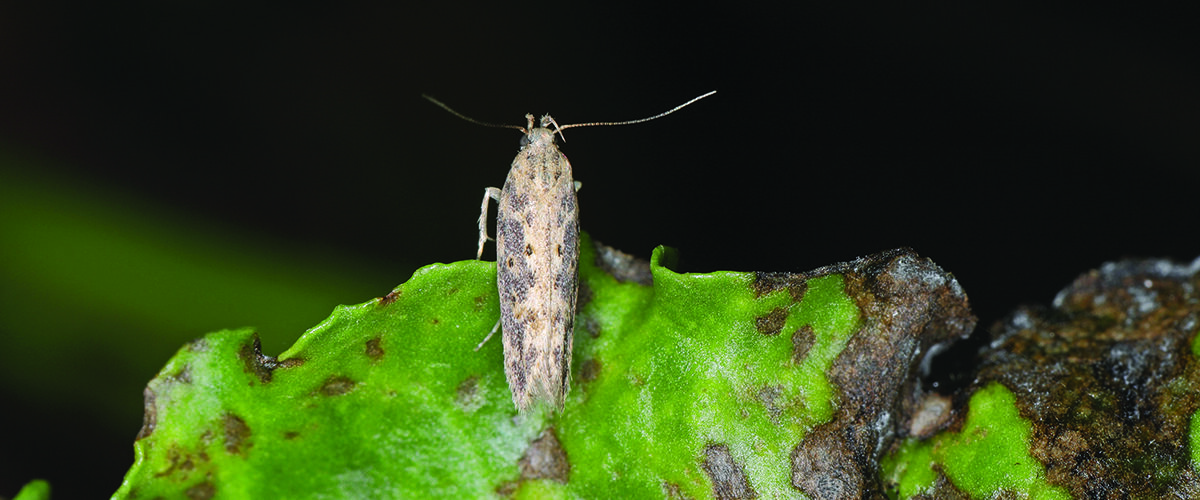
A key pest has risen up the risk agenda for sugar beet growers, with the 2025 season marking a shift from isolated cases to economically damaging infestations.
First noticed in UK crops just five years ago, beet moth is now here to stay, agronomists were told at the recent Association of Independent Crop Consultants (AICC) conference, held at Towcester, Northamptonshire.
“Unfortunately, I think it’s established itself and it’s one that we’re going to have to keep a very close eye on going forward,” said Mark Stevens, crop protection lead at the British Beet Research Organisation.
Widespread damage last season was most evident during prolonged warm, dry spells, particularly on lighter soils where drought stress left crops exposed and allowed moths easier access to the beet crown.
‘Exceptional levels’
“The worst impacts went hand-in-hand with drought conditions. Where crops collapsed and the canopy opened up, adults were easily able to get in, reproduce, lay eggs and continue reproducing right through the summer.”
In badly affected fields, populations reached exceptional levels. “We found 50-60 caterpillars per plant in some samples,” said Prof Stevens. Feeding led to secondary infection and, in some cases, total defoliation.
Pressure was greatest in parts of East Anglia, especially along the A14 corridor from Bury St Edmunds through Newmarket and Cambridge, spreading north where dry conditions persisted. But the pest did not behave as older literature suggests.
“If you read the textbooks, they talk about two migration periods separated by six to ten weeks. That’s not accurate. Once they started, every week you had another flush. Overlapping populations put a lot of pressure on any [insecticide] product.”
Pest management
An AICC conference poll found about 60% of agronomists recommended an insecticide on at least one crop in 2025. Nearly half relied on pyrethroids, while only a small proportion used the emergency-authorised diamide product Coragen (chlorantraniliprole).
For 2026, Prof Stevens suggests that beet moth must be managed through integrated pest management rather than reactive spraying once damage is visible. “I get very nervous about pyrethroid use late in the season, particularly in August and September, when beneficials and aphids are building for the following season. The last thing you want to do is remove those beneficials and create problems for the next crop.”
Physical barrier
“There are no UK thresholds at the moment. The French use 10% of plants showing damage, but I’d argue that’s probably too late, given what we now know. Instead, early canopy development and reducing crop stress is important.”
Early sowing to get that canopy up – and water where it’s available – are important, says Prof Stevens. “The canopy is a physical barrier and where heavy rain kept canopies intact in 2025, we saw far less impact.”
Monitoring will take on greater importance. “There’s no point monitoring if we’re not getting that information out quickly.”
Further approvals or new chemistry may emerge, but growers are warned not to rely solely on products. “If we get another prolonged drought, everything is going to have to come into play to keep on top of it.”
Independent agronomist viewpoint – Tim Martin, Apex Agronomy
 Suffolk grower Tim Martin had seen beet moth locally for several seasons. It became a major issue last year, particularly on light Breckland soils, he says. “Where beet was already under drought stress, it tipped crops over the edge. In severe cases, complete defoliation occurred in some areas within crops by mid-September, and yield loss would have been 30-35%.”
For the coming season, he stresses the importance of strong establishment and early canopy growth. Reducing compaction, encouraging deeper rooting and conserving soil moisture all help crops grow away from damage.
Irrigation, where available, can limit impact in dry periods. Cultivation may also play a role. Beet moth can overwinter as pupae and larvae in beet crowns.
“By ploughing them deep into the soil, you make emergence more difficult in spring. Evidence is still limited, but it’s a pragmatic step where problems have been severe.”
Insecticides remain a last resort, but 2025 showed they can have value. Coragen performed better than early assessments suggested, with treated crops finishing in stronger condition. Timing remains critical, making BBRO monitoring data important.
“Ideally, you would target adults, but that’s very difficult. Larvae feeding on treated leaves can be controlled, but spraying when larvae are small and before they are deep in crowns is crucial. Essentially, it comes down to monitoring conditions and carrying out a risk assessment. If it’s dry again then action may be required.”