


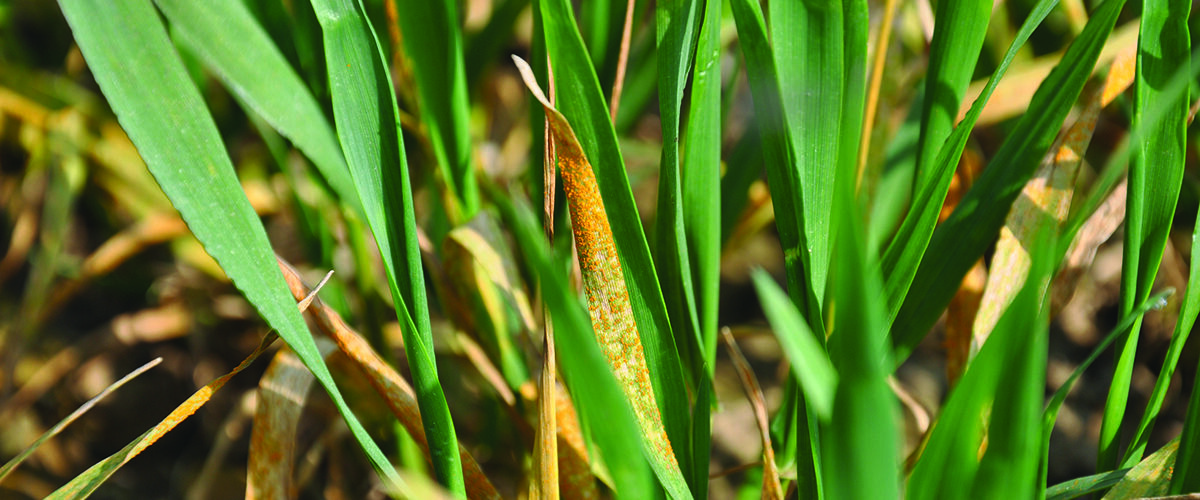
 Wheat growers are being urged to reassess their fungicide strategies after a new race of yellow rust overcame the widely used YR15 resistance gene in winter varieties.
Speaking at the Association of Independent Crop Consultants (AICC) annual technical conference, Jonathan Blake of ADAS said the breakdown marked a significant shift in yellow rust epidemiology.
It may also expose weaknesses in septoria-focused spray programmes, said Mr Blake. “That gene has been widely used in wheat breeding programmes, and ratings and susceptibilities have changed.
“But they’ve changed by varying degrees, depending on the variety, with some more reliant on the YR15 resistance gene than others. It makes monitoring of crops more critical than ever this year.”
Rising pressure
Mr Blake reported an “almost exponential rise” in yellow rust over the past two to three years. Although last season was less conducive — with widespread frosts and dry conditions — rust persisted into June in some regions.
“Despite this, yellow rust was still observed in crops well into June across some regions. My fear is if we have a season that is more conducive to yellow rust, this could be a major problem.”
Mr Blake highlighted differences between yellow rust and septoria, particularly cycling speed. Septoria has a latent period of just over three weeks in May with temperatures averaging 10C. But yellow rust is closer to 15 days during the same period
With four weeks typically separating T1 and T2, yellow rust can complete at least one infection cycle between sprays, leaving leaf two exposed. Severity is often highest on leaf two rather than leaf three – the opposite of septoria.
“This explains why trials often show a clean leaf 3 and flag leaf, but a heavily infected leaf 2. Our programmes are timed around septoria control, but yellow rust is quite a different beast.”
Given the shorter latent period, Mr Blake suggests reconsidering the role of a T1.5 spray on susceptible varieties or where rust is present early.
In a high-pressure trial at ADAS Terrington, a five-week gap between T1 and T2 allowed yellow rust to dominate. Adding a T1.5 spray targeting leaf two changed the outcome.
“If you’ve got yellow rust present at T1 and you’re applying a treatment, then walking away and expecting to come back four weeks later and not see any disease – that’s optimistic.” With weakened resistance, T0 sprays should also be considered routine on susceptible varieties. “T0 is a given. It is one way to reduce that initial inoculum at T1 and make sure we’re in a preventative scenario.”
While product choice matters, timing is critical. Reliance on ratings alone is no longer sufficient. “I am concerned that varietal susceptibility may have been underestimated. If the YR15 race is ubiquitous next year, things could be very different.”
Mr Blake advises early monitoring, tailoring programmes to rust risk and ensuring leaf two is protected.