

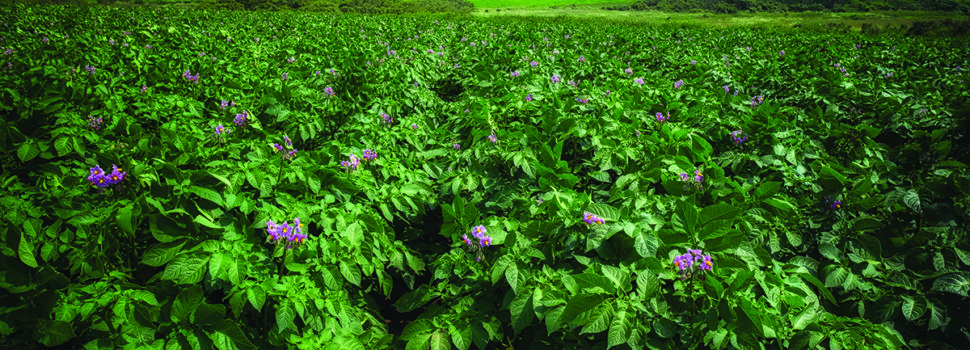


 Helping potato crops cope with the increasing pressures of both pests and weather extremes is becoming a key priority for growers.
Integrating biological products alongside conventional agronomy tools can help crops perform more consistently and reach their full potential, says agronomist Andrew Goodinson, a Potato Industry Award winner with Hutchinsons.
“Setting up the crop to withstand both biotic stresses such as pests and diseases, and abiotic stresses such as heat, drought or nutrient limitations, should be a central focus of crop management in the coming season,” he says.
Biostimulants are becoming increasingly valuable in achieving this, believes Mr Goodinson. “It’s similar to giving colostrum to a newborn lamb or calf – it provides an early boost that helps strengthen the system.”
The products work by stimulating or enhancing natural plant processes, says Mr Goodinson. They improve nutrient efficiency, support plant growth and strengthen tolerance to environmental stress.
Formulations
A range of biological products is now available, including seaweed extracts, humic substances, amino acids and microbial formulations. Each has slightly different modes of action but broadly works to support plant health and crop performance.
“By influencing gene expression within the plant, biostimulants can trigger physiological responses that enhance nutrient uptake, improve root development and strengthen plant resilience,” says Mr Goodinson.
Hutchinsons has been evaluating several biostimulants in potato trials over a number of seasons. Results suggest certain products can play a valuable supporting role alongside conventional fertiliser and crop protection programmes.
“Some products help activate plant defence responses, while others stimulate root development and nutrient uptake. Phosphite-based products, for example, can encourage root growth and stimulate plant metabolism by increasing nitrogen reductase activity.”
Effectiveness
“Combining biological products with nutrients can also improve their effectiveness. Adding zinc to a phosphite treatment, for instance, can enhance phosphate mobility within the plant.
“Root development is particularly important in potato crops, as it helps maximise nutrient uptake and supports tuber quality. Some biostimulants have been shown to enhance calcium uptake, which can reduce the risk of quality defects such as internal rust spot.
Calcium deficiencies can be particularly problematic on light or sandy soils, says Mr Goodinson. Because calcium must be absorbed through the roots rather than the foliage, correcting deficiencies later in the season can be challenging.
“Improving root development early in the season can make a significant difference to how effectively the plant accesses nutrients such as calcium,” he adds.
Different biological products are most effective at specific stages of crop development. Applications may be targeted to support germination, root establishment, vegetative growth or tuber development.
Treating planted seed with a biostimulant can help promote uniform emergence and stronger early growth. This can be particularly beneficial when working with physiologically aged seed, which can sometimes lose vigour and senesce prematurely.
“We’ve seen situations where applying a biostimulant to planted seed improves emergence and helps crops maintain stronger growth throughout the season,” says Mr Goodinson.
Biostimulants can also be used strategically to help crops cope with periods of environmental stress, he suggests. Heat stress, for example, can affect photosynthesis and slow crop development, particularly in varieties sensitive to high temperatures.
“In our trials we’ve seen yield increases of up to 19% where the appropriate stress-reducing biostimulant was applied ahead of a heat event. Timing is crucial. Stress mitigation products are generally most effective when applied before the crop experiences adverse conditions. If hot weather is forecast and the canopy has not yet closed, applying a stress-reducing biostimulant ahead of the event can help protect the crop.”
Development
Biological products can also play a role later in the season when applied in-furrow, as seed treatments or during early canopy development.
“When used alongside nutritional programmes and applied around hook stage or tuber initiation, some products can help increase the number of viable tubers set. Maintaining a healthy canopy for longer can also extend the bulking period, ultimately supporting yield. The use of biological products is not intended to replace conventional inputs but rather to complement them,” says Mr Goodinson.