




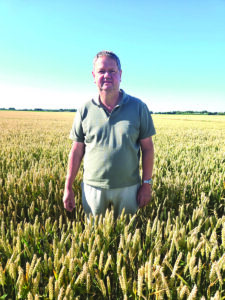
 A new winter wheat variety is attracting interest from growers looking for reliable performance across a range of soils, drilling dates and seasons.
Bred by RAGT Seeds, RGT Hexton is in its first year of widespread commercial availability. But it has already shown strong disease resistance and consistent performance under contrasting growing conditions. Early experience suggest Hexton it combines competitive yields with robust disease resistance and management flexibility. That combination could make it a strong replacement for ageing farm favourites.
Farm experience
David Suckling, who farms near King’s Lynn, Norfolk, grew Graham for several years before deciding it was time to move on. “I think certain varieties suit certain types of land,” he says.
“When you get onto a good variety, then it is worth sticking with it. We grew Graham for years and got on very well with it, but I felt it was getting a bit outclassed, and that’s when we needed to move on to something with a better yield.” Mr Suckling decided to grow 10ha of Hexton after visiting Agrii’s variety trials at Stow Longa, where he discussed trial results with John Miles, Agrii’s technical manager for seed. “My agronomist Miles Doncaster agreed with John Miles that Hexton would be worth trying, which is why I ordered enough to have a go last summer.”
This season’s high yellow rust pressure has reinforced that decision. Mr Suckling says Hexton has remained clean throughout the season. That has also reduced fungicide costs compared with some of the other varieties on the farm.
Trial performance
Hexton has also impressed at Shuttleworth College’s 500-acre Kingshill Farm, where Frontier variety trials allow students and local growers to compare new genetics under commercial conditions.
Head of farming and resources Shane Durham was looking for a successor to Tapestry and Skyscraper when Hexton caught his attention.
As a working commercial farm and learning environment, Kingshill means Shuttleworth students can see first-hand how crop performance is assessed, analysed and applied in real-world farming decisions.
“We are proud to support agricultural crop trials to help our students and local farmers evaluate the latest crop varieties under local growing conditions. It gives us an opportunity to see which do well. Hexton was one that caught our eye.” The farm’s silty soils are vulnerable to slumping during wet winters and surface capping after heavy rain. That makes rapid establishment important. Shane says the variety suits the farm’s preference for earlier drilling. “We like that we can get Hexton in relatively early, and it gets away nicely before the winter. It has remained clean from disease all season, whereas we have had a lot of problems with rust with our other varieties this year.”
Broad appeal
RAGT arable technical manager Andrew Creasy believes growers are already exploiting the variety’s strengths.
“Where they have sown Hexton, we are seeing farmers play to its strengths. It’s a great early sown wheat with steady autumn growth and decent yellow rust resistance, and it also performs well as a second wheat.”
The best farm varieties earn their reputation through consistency rather than headline Recommended List yields, says Mr Creasy. Hexton could replace some ageing farm favourites, he suggests.
“We have seen Hexton’s yellow rust resistance stand up well under this season’s high pressure – it has diverse rust resistance that builds as the season progresses. We haven’t heard of any issues struggling to manage the disease this season, which is a really useful management consideration given the proportion of varieties susceptible to yellow rust being grown on farm at the moment.”