

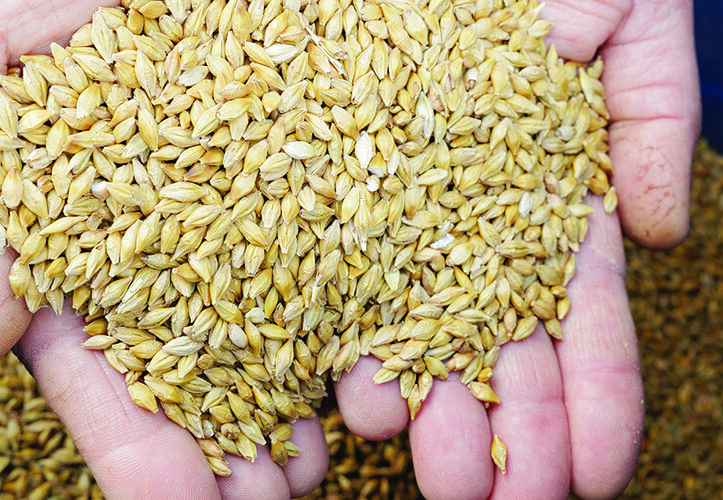
Growers are being advised to focus on proven varieties with strong market flexibility when selecting spring barley seed. Uncertainty over area, premiums and end-market demand continue to shape decision-making this season, says malting barley trader Laura Jones, of Saxon Agriculture.
Premium possibilities
British farmers consistently produce some of the highest-quality barley in the world, says Ms Jones. But malting premiums have remained under pressure in recent seasons due to an oversupply of barley both domestically and across Europe, coupled with declining demand.
Early indications suggest spring barley area could fall by more than 15% this year, potentially creating improved premium opportunities compared with the past two seasons.
Changes in cropping plans following recent wet winters are expected to see winter wheat area increase at the expense of winter and spring barley.
Spring barley area is forecast to be down by more than 15%, according to AHDB surveys, which could support premiums. But it is still the UK’s second-largest crop behind winter wheat and good marketing remains essential with demand significantly contracting year on year.
Market uncertainty means growers should consider how and when they market malting barley – as well as what they grow, says Ms Jones.
“In a volatile market, decent yields combined with the opportunity to lock in premiums early can make a real difference,” she adds. “We’ve seen how quickly things can turn, and malting barley is one area where forward selling has consistently helped growers manage risk.”
Risk management
Jonathan Baxendale, Saxon Agriculture’s head of seed trading, says variety selection in malting barley should be driven by end-market access and proven performance.
“Our advice is to focus on varieties with the widest range of marketing options. Growing a new or niche variety without a contract or a clear end market at the point of drilling can significantly increase risk.”
Evidence of this approach includes continued dominance of established varieties. Dual-purpose variety Laureate, suitable for both malting and brewing, currently accounts for around 60% of the certified spring barley seed market.
“Laureate remains popular because it’s well established, widely accepted and gives growers the highest chance of finding a home if quality is achieved,” explains Mr Baxendale.
Skyway, a brewing-only variety, has also gained ground, now accounting for around 14% of the English certified seed market. It offers higher yield potential than older brewing varieties, alongside a high bushel weight and good straw characteristics.
“The key is choosing varieties that align with realistic marketing routes and having those conversations early.”
While the advice this season is to stick largely with established varieties, Mr Baxendale notes that new options are emerging. Belter and SY Arrow are potential new dual-purpose varieties offering a yield advantage over Laureate.
Limited contracts
“There are currently limited contracts available, so growers should speak to their grain merchant before securing seed,” he advises.
Annual demand for UK malting barley has dropped from 1.9 million tonnes to 1.7million tonnes over the past two seasons – so early discussions around both variety choice and marketing strategy remain essential, explains Ms Jones. “This is a year for realism – understanding your market, choosing varieties that offer flexibility, and using forward contracts where appropriate to protect value.”