

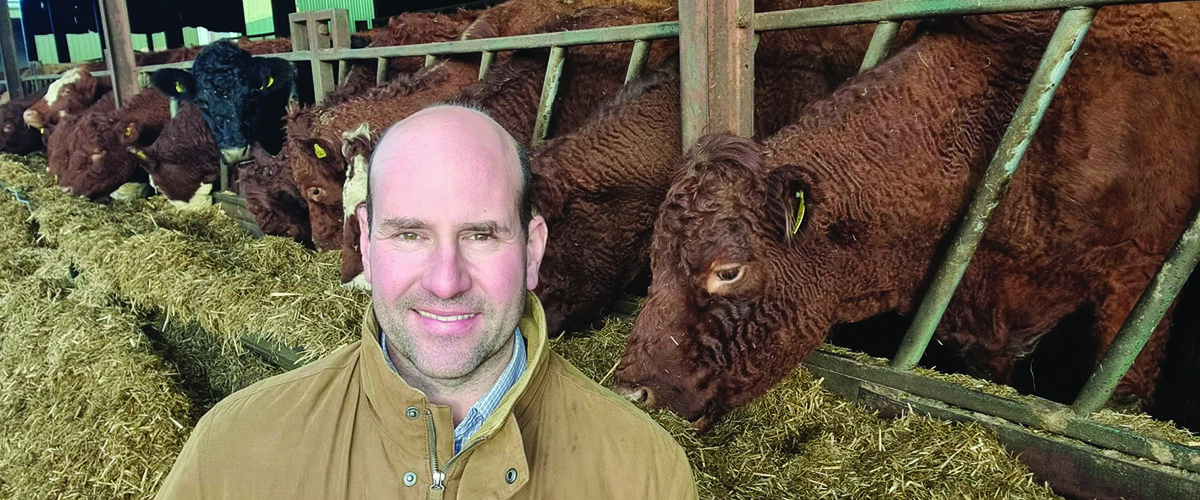
 A Northamptonshire beef and arable farmer has halved his feed costs by switching to home-grown cereals.
Harry Brown, who farms 1,700 acres at Potcote Farm, near Towcester, said rising production costs and weak grain markets pushed him to rethink his feeding strategy.
Instead of selling more oats and barley into depressed commodity markets, the farm now feeds much of the grain to weaned calves using a mobile bruising and mixing service supplied by Harbro.
Reduced exposure
The move to Harbro’s Super Bruiser service has reduced ration costs by as much as 50 per cent compared with bought-in feed, while maintaining cattle performance.
“We run 200 Salers here and bull them with a Hereford to calve in the spring, with the resultant calves sold as yearlings,” said Mr Brown.
“In the past, we would have fed the weaned calves on silage and a standard beef nut, but with oats and barley proving difficult to sell, we’ve been using our own cereals to make a home-grown feed, which is when Harbro’s Super Bruiser service is used.”
Other farmers are also reducing exposure to volatile input prices and weak commodity demand. Feed us one of the largest costs in beef production, particularly during winter.
Mr Brown said lower cereal prices had strengthened the economics of feeding grain on farm rather than selling it.
“It can work out up to 50% cheaper depending on the value of the feeds used at the time, compared to an equivalent bought-in ration,” he said.
Oat prices have been particularly weak over the past year. Mr Brown said values had slipped to about £130/t, compared with more typical prices of £160-£170/t.
The farm grows wheat, barley and spring beans across predominantly arable land. Historically, much of the crop was sold into milling and distilling markets. But weaker demand for some cereals has altered that balance.
Lower values
“It all depends on the value of the individual feeds you have on farm as to how much you can save,” said Mr Brown.
The Harbro machine bruises and mixes cereals on farm. Mr Brown said the system was significantly faster and more efficient than conventional on-farm mixing equipment.
“We have mixed our own rations before, but when the Harbro machine comes into bruise, it is so much more efficient, when it can bruise/mix 30-40 tonnes an hour.”
The business adjusts rations depending on cattle age and production stage. Young calves receive a ration based mainly on oats and beans, with molasses added to improve palatability. Barley inclusion increases after weaning.
“We don’t creep feed the calves until the end of July/beginning of August, depending on grass availability,” Mr Brown said.
“At this stage, we mix a feed made up of mostly oats and beans with molasses added for palatability. Once the calves are weaned, we increase the percentage of barley in the ration and provide ad-lib grass silage taken from two cuts per year.”
Feeding strategy
The farm previously relied on grass silage, maize and purchased beef nuts during the winter months. Mr Brown said cattle had performed equally well on the revised system.
“We have fed the calves grass silage and maize alongside a beef nut over the winter in the past, but we have found that they do just as well and they’re just as healthy when they’re fed a home-grown ration.”
The approach also gives the business greater flexibility when feed markets move sharply.
“Super bruising is a very efficient way of utilising the arable crops you have on farm, compared to a traditional mixing/bruising machine,” Mr Brown said. “We use it to mix our beans, barley and oats, but you don’t have to use those three crops. It can be used on cereals with a bought-in protein, or whatever is of good value at the time.”
The machine only needs to visit the farm every four or five weeks during autumn and winter because of its throughput.
“We’ve relied on Harbro’s Super Bruiser for a couple of years now, and I would have to say the machine is extremely efficient. It goes at a phenomenal speed and therefore is only needed every four or five weeks during the autumn and winter months.”
Margin pressure
The shift comes as livestock producers face continued pressure on margins from high input costs and uncertain farmgate returns.
Mr Brown said controlling costs had become increasingly important because farmers had little influence over the prices they received for their produce.
Since changing the feeding system, cattle performance has remained stable while overall production costs have fallen sharply.
For the business, the biggest gain has not been higher output but improved resilience.
With volatility across both arable and livestock markets, feeding more home-grown grain has allowed the farm to extract greater value from crops already in the rotation while reducing reliance on purchased feed, explained Mr Brown.