

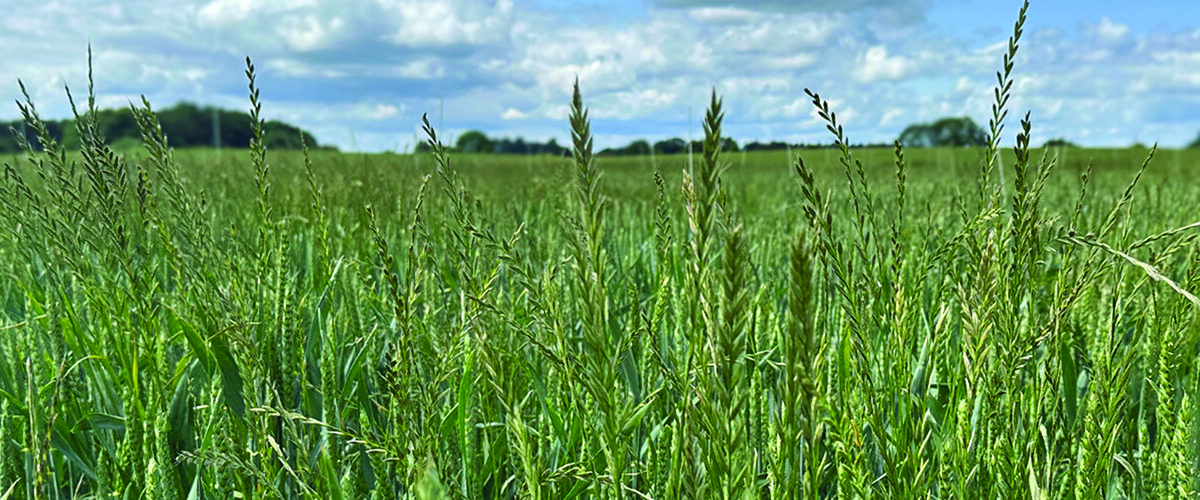
 Italian ryegrass control must exceed 97% to prevent populations increasing – putting greater pressure on growers to combine cultural measures with robust pre-emergence spray programmes.
The benchmark is particularly important as concerns grow over herbicide resistance, including the discovery of glyphosate-resistant populations in the UK two years ago, says crop protection company Gowan. Greater than 97% control remains achievable, even where populations are high, but growers may need to invest more heavily in short-term control, explains Gowan UK country manager Hank King.
“One of the big issues with ryegrass is that it continues to germinate through the autumn, as opposed to black grass, which tends to germinate in early autumn, and then again in the spring,” says Mr King. That prolonged emergence makes Italian ryegrass particularly difficult to manage. It also reduces the effectiveness of delayed drilling compared
Drilling strategy
Growers with predominantly ryegrass populations may therefore have greater flexibility to drill earlier without significantly reducing their prospects of successful control, says Mr King.
But the extended germination period puts more emphasis on residual herbicides. A strong pre-emergence treatment followed by a peri-emergence application can extend protection as new plants emerge.
“We are asking our herbicides to cover a long period of time, so good sequences are essential. It starts with the pre-emergence; if we don’t get this on in good time, then we will struggle for the rest of the season,” he adds.
Gowan considers cinmethylin the most effective base treatment for Italian ryegrass, although Mr King says it will not achieve the 97% threshold alone in most situations.
Stacking effective modes of action is therefore important. “We’ve seen consistently in trials that combining this with Avadex (tri-allate) gets you up to kinds of levels on control to ensure you reduce populations rather than build them.”
Wider spectrum
Tri-allate can also broaden the weed spectrum where growers face mixed populations, according to Gowan. It provides additional activity against black grass, brome species and wild oats. The longer-term risk from inadequate control is illustrated by experience in Australia, where Italian ryegrass has developed widespread resistance to several herbicides. Research from the Australian Government’s Grains Research and Development Corporation found 40% of ryegrass samples collected in 2024 showed either low or high resistance to glyphosate.
Martin Dargan, who supports Gowan in Australia and New Zealand, says growers have consequently become increasingly dependent on pre-emergence programmes. “Our post-emergence options have a minimal effect, so we need to control ryegrass pre-emergence,” he says. “Used standalone, even the most effective products only provide 90% control.”
The arithmetic explains why apparently high levels of control may still allow populations to escalate. “If you have 500 ryegrass plants per square meter and kill 90%, you will have 50 plants per square meter that will go to seed, returning 500–1,000 seeds each. It’s a numbers game.”
Australian advice has consequently shifted from simply rotating chemistry towards combining different modes of action while continuing to rotate them between treatments.
“We’re now adding different chemistry groups together pre-emergence, and that’s where Avadex has been exceptional. We’re using it as a partner to the base treatment to take control from 85% to 100%.”
For UK growers, the lesson is to tackle high populations before resistance further restricts herbicide options. That can mean higher expenditure initially, but reducing the ryegrass seedbank should lower control costs over subsequent seasons. “Our experience shows you have to mix multiple chemistries up-front to get on top of resistant ryegrass.”