

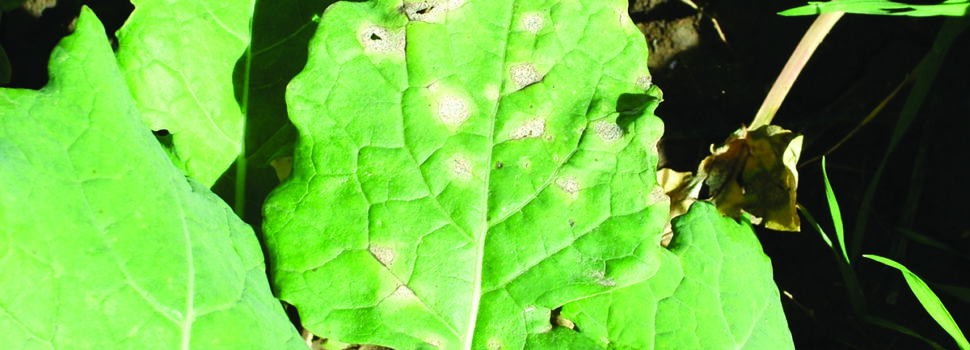
Light leaf spot is prompting renewed calls for growers to prioritise varietal resistance when sowing oilseed rape this coming season.
Scientists have been examining leaf samples submitted through the Spore Scout campaign. They found evidence of the disease across the country, with many crops showing significant levels of infection. The findings suggest light leaf spot is no longer predominantly a northern problem and is becoming more widespread – making it an increasingly important consideration for growers in England as well as Scotland. The results come as the industry seeks to rebuild confidence in oilseed rape after several challenging seasons marked by pest pressure, disease losses and shrinking crop area.
Farmer-led results
The survey forms part of the £2.5m, three-year Defra-funded LLS-ERASED project, led by the British On-Farm Innovation Network (BOFIN) and involving 11 partner organisations.
The initiative combines disease monitoring, precision breeding and farmer-led field trials to tackle one of the crop’s most costly diseases.
Researchers at the University of Hertfordshire assessed leaf samples submitted by growers and agronomists before incubating them to isolate the pathogen responsible for infection. The work provided an early snapshot of disease pressure across different regions and varieties.
Disease spread
Yongju Huang, professor of plant pathology at the University of Hertfordshire, said the findings highlighted the importance of resistance when selecting varieties.
“Overall, the Scottish samples showed higher levels of disease severity than those from England, although there were some interesting exceptions,” she said. “For example, the level of disease we observed on the cultivar Crusoe in Edinburgh was similar to that seen in Crusoe samples from Cirencester. Traditionally, we have associated the most severe light leaf spot pressure with Scotland, but these findings suggest significant disease levels are now being seen much further south as well. This highlights how disease pressure can vary between seasons, varieties and locations, and reinforces the importance of growers looking carefully at resistance ratings when making variety choices.”
The survey also offers researchers an opportunity to build a deeper understanding of how pathogen populations differ between regions and how varieties perform under commercial field conditions.
“As growers start thinking about drilling plans for autumn 2026, these findings are a timely reminder that genetic resistance remains one of the most important tools for managing light leaf spot,” Prof Huang added. “Choosing varieties with good resistance can help reduce disease pressure and improve the resilience of crops throughout the season.”
Of the samples submitted, 65% produced sporulation suitable for single-spore isolation. Scientists are now establishing pathogen isolates that will be tested for pathogenicity as part of the wider programme.
The resulting data is expected to contribute to future disease forecasting systems and management strategies. The Spore Scout campaign will be repeated in 2027 and 2028 to build a more detailed national picture of disease development over time. The stakes are high. Light leaf spot is estimated to cost the UK oilseed rape sector around £300m annually in lost yield and crop performance, making it one of the industry’s most economically damaging diseases.
Breeding focus
Project partners believe tackling the disease will require a combination of improved forecasting and new genetic solutions. At the centre of the programme is an effort to bring precision-bred oilseed rape onto commercial farms for the first time in Europe.
The project is taking advantage of England’s unique regulatory position following the Genetic Technologies (Precision Breeding) Act 2023 and subsequent legislation. England is currently the only European country where precision-bred crops can be trialled legally in farmers’ fields.
Researchers hope the technology can accelerate the development of improved varieties by introducing beneficial traits more quickly than conventional breeding methods.
A key focus is a newly identified plant susceptibility gene linked to light leaf spot infection. Rather than introducing a resistance gene, scientists are attempting to remove a weakness within the plant that the pathogen exploits to establish infection. Work at the John Innes Centre has shown that removing this susceptibility can significantly reduce the pathogen’s ability to infect crops. Researchers believe this approach may offer more durable protection than traditional resistance genes, which pathogens can eventually overcome.
“I’m excited to move this work from the laboratory into field-scale trials,” said Rachel Wells, of the John Innes Centre. “Precision breeding gives us the opportunity to develop material to combat pests and pathogens while supporting more sustainable farming systems. Developing a trusted pipeline to streamline the process from research to variety release will be invaluable for crop improvement.”
Farm evidence
The project’s commercial significance extends beyond disease control. Success could provide an important proof of concept for the wider adoption of precision breeding technologies across UK agriculture. Project leaders acknowledge that laboratory results alone will not determine whether the technology succeeds. The next phase centres on commercial-scale field trials designed to test whether the genetic changes translate into measurable benefits on farm
Tom Allen-Stevens, managing director of BOFIN and project lead, said practical performance would ultimately determine the value of the technology.
“Whether these traits can genuinely reduce susceptibility, reduce reliance on chemistry and give growers confidence to keep oilseed rape in the rotation is what this project is designed to find out.” Project partners hope that combining precision breeding, integrated pest management and farmer-led testing will create a platform for tackling other major oilseed rape challenges, including cabbage stem flea beetle.
Risk management
The wider objective is to improve risk management for growers and support the long-term viability of a crop that remains one of the UK’s most important break crops.
“This project is about giving growers better tools to manage risk,” concluded Mr Allen-Stevens. “Reducing a plant’s susceptibility through precision breeding has huge potential, but it needs to work alongside improved forecasting, pathogen monitoring and practical farm-based testing if it’s going to deliver meaningful change that will give oilseed rape the reboot it needs.”