


 Rising input costs and volatile commodity prices are putting whole-farm efficiency under renewed scrutiny – making the right crop varieties increasingly important to both profitability and sustainability.
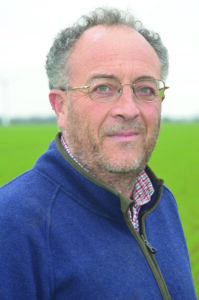
Widely known for growing top-performing crops, Norfolk farmer Mark Means is the third generation to manage JS Means (Terrington) Ltd, which has been based at Terrington Marsh since 1963.
Sustainability is embedded in every aspect of this progressive family business. LEAF Marque certified since 2002, it carries out carbon auditing using the Cool Farm model and sustainability metrics to drive the business forward.
Managing over 900ha of land within 5km of The Wash, Mr Means grows 540ha of wheat, all hand-rogued to minimise blackgrass. The aim is to intercept as much sunlight as possible to maximise yield without creating excess biomass to minimise lodging.
His success as a grower was recognised in 2022 with the British Farming Awards’ Sustainable Farmer of the Year title – followed by winning Farmers Weekly’s Farmer of The Year in 2024. For harvest 2026, 20% went into the hard Group 4 feed varieties KWS Scope and KWS Parkin for early combining, 10% went into Group 2 KWS Palladium for Warburtons, with the remainder split between Group 1s KWS Zyatt (30%) and KWS Vibe (40%).
Variety strategy
“The fact that the farm has moisture down to two metres is a saving grace in a dry season. Soils are our greatest asset and range from silty loam to silty clay with an average pH of 8 – 8+ and indices of 2 and 3 for P and K,” he explains. “Looking after them is my main priority and all decisions are based around that principle. So far, we’ve increased our soils’ organic matter by one per cent, which has made them more resilient to adverse weather, but there’s a limit to how far we can go; probably 4% to 4.5%. Wheat is the best cultivator and subsoiler we have, so our aim is to create deep, ‘adventurous’ rooting structures which maximise the crop’s opportunity to access nutrients and water. The bigger the crop, the bigger the yield, the bigger the roots and the more organic matter which goes back into the soil.”
When it comes to wheat, the focus is on selecting top-performing varieties. Early maturity is a key trait with the intention of making an early start to harvest, spreading the workload and minimising risk.
Crop priorities
Yield and nitrogen efficiency are also critical, the aim for feed wheat is to achieve 10.5% to 11% protein with optimum yield. Standing power is essential, as failure can reduce it by 25% and compromise quality.
“We’re not in a Nitrate Vulnerable Zone (NVZ) and our soils hold nitrogen, so the goal is to get crops developing and tillering as early as possible. We’re generally happy to push wheat while moisture is available, with a first application of nitrogen in February followed by two in March. We’ve got nitrogen sensors on the sprayer and spreader and our minimum rate for milling wheats is 250kgN/ha in four or five applications. That’s up to 130kgN/ha more than for feed, requiring a substantial premium to offset the significant additional costs and risk.”
Nitrogen efficiency has become a key measure. This is where KWS Vibe, all forward sold on contract, excels. Mr Means has reduced the total amount applied this season by 30kgN/ha, from his normal 300kgN/ha to 270kgN/ha, with the expectation of still meeting milling quality.
“KWS Vibe fits our profile for a Group 1 because it is short, stiff strawed, matures just behind Zyatt and Palladium, has excellent all-round disease resistance and produces extremely high treated and untreated yields. We are in our third season and have been very pleased with how it has performed. It has always been very clean, consistent and nitrogen efficient. Crucially, it had no yellow rust last year and there’s not been any this season, which is quite something given that we are in a hot spot for this disease.”
Field results
Mr Means first grew KWS Vibe for harvest 2024, as a first wheat for seed following vining peas which were estimated to contribute 30kgN/ha.
The crop was drilled on 28 September, which was earlier than normal and increased the Septoria risk compared with late-sown KWS Zyatt, but had it gone in at the same time the relative risk would have been lower.
One field which received 247kgN/ha yielded 11.2t/ha at 13.6% protein. Another, which had 235kgN/ha, recorded 11.5t/ha at 12.3% protein.
This data was used to calculate that in the first field every 1kgN applied to KWS Vibe had produced 5.5kg of protein, while the other field produced 5.4kg of protein per 1kgN.
Protein gains
Applying the same calculation to a crop of KWS Palladium, grown in a field which is into continuous wheat and receives manure, he found that it produced 11.2t/ha at 12.6% protein, equivalent to 4.6kg of protein per 1kgN.
For comparison, KWS Zyatt grown as a second wheat yielded 11.07t/ha at 12.9% protein, equivalent to 4.1kg of protein per 1kgN.
The figures were all higher than for Crusoe, one field of which received 313kgN/ha, yielded 9.3t/ha, and produced 13.4% protein, equivalent to 4.0kg of protein per 1kgN, while another yielded 8.6t/ha at 12.2% protein, giving 3.3kg of protein per 1kgN.
“Looking from a yield and protein perspective the yield of protein per hectare was 23% increase over Crusoe with 20% less N from the bag and soil,” says Mr Means. “That is amazing and was replicated in 2025. We aimed to have a fungicide cost for harvest 2026 at under £100/ha for KWS Vibe and it has given me the confidence to save and reach its full potential. Based on my results, KWS Vibe produces more protein per kilogram of nitrogen applied than those other varieties, although we still don’t really know why. But its consistent yield, Hagberg, specific weight and quality give me great confidence.”