

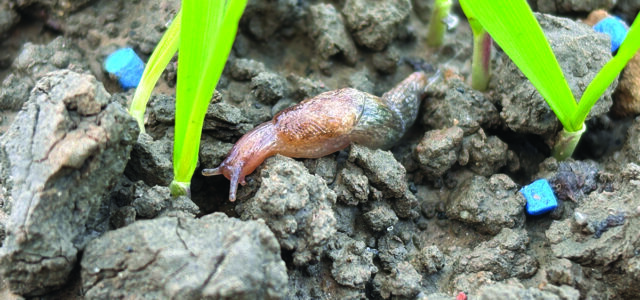
Recent rain has restarted autumn drilling and revived the prospect of serious slug damage in emerging crops after the dry summer, ADAMA UK has warned.
Growers are being reminded to monitor fields, study forecasts and prepare calibrated spreaders. Slug pellets should be used only after surface activity is confirmed and when settled weather will protect the application.
“Given how hot and dry conditions were throughout the summer, there’s an assumption that the threat posed by slugs could be reduced this autumn,” said David Griffiths, technical manager for crop protection specialists ADAMA UK. “Unfortunately, that’s not strictly true as although slugs need moisture to remain active, they are exceptionally well adapted to surviving adverse conditions.”
Wet weather prompts surviving slugs to seek fresh seedlings. Damage at emergence can destroy entire plants. Delayed treatment can therefore expose growers to establishment losses.
 Regular slug counts are a priority. Growers should also check the forecast closely, said Mr Griffiths. Spreaders should be calibrated and ready once slugs appear and a favourable, settled period is expected. “Slug pellets should only be applied once slugs have been seen on the soil surface, and only if weather conditions are favourable,” he added.
Precision
Products should not be spread immediately before heavy rain because poorer quality pellets can degrade quickly. A failed application can leave seedlings exposed. Pellet dimensions, weight and shape influence spreading ballistics and application accuracy. Equipment must be set up correctly. ADAMA recommends a forward speed of about 12kph to maintain a consistent spread.
Two key pellet types from ADAMA are manufactured to a 2.5mm by 2.0mm specification. Gusto Iron contains 2.94% ferric phosphate, while Ferrabait contains 1% elemental iron. At typical field rates, both products are designed to provide 40 to 50 baiting points per square metre. Their bright blue colour allows growers to assess coverage in seedbeds and judge when a second application is needed, says Mr Griffiths.
ADAMA claims the two products suppress slug appetites after ingestion. Its Desidro Technology uses a two-stage drying process intended to balance wet-weather persistence with palatability and improve resistance to mould. Independent trials cited by the business found that both pellets retained their shape, colour and palatability and remained mould-free for up to a week longer than other leading brands in wet conditions.
“Developing and manufacturing high quality slug pellet takes a lot of time, research and testing,” said Mr Griffiths, “so it isn’t safe to assume that different products will offer the same level of protection.”



Crushed farmer urges rethink on farm safety
News Oct 1, 2026

Drought could last another six months
News Sep 28, 2026

Veteran paddlers launch £10,000 YANA challenge
News Aug 27, 2026


Poignant hi-vis reminder on farm safety
News Jul 31, 2026
