

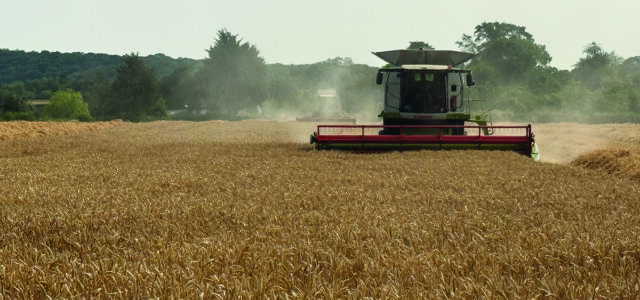
Sparkler winter wheat has won repeat orders from growers after topping yields on two farms despite prolonged drought and an unusually early harvest.
The Group 4 soft wheat yielded up to 8.65t/ha during its first commercial season since joining the Recommended List in December 2025. Growers also reported good standing ability and relatively straightforward disease management.
For Shropshire farmer Andrew Dalton, the result prompted a fivefold increase in the area planned for this autumn. Mr Dalton, who farms near Bridgnorth, grew just over 8ha of the variety last season. It was drilled at 115kg/ha on 19 September.
Farm results
The crop received a standard pre-emergence herbicide followed by a post-emergence treatment and aphicide. A conventional four-spray fungicide programme was used, with no additional rust treatment required.
“Overall, I would say it was pretty straightforward to manage despite the presence of yellow rust in our crops,” said Mr Dalton, who is drilling 40ha of Sparkler this autumn. It stood well, remaining pretty clean throughout the year, and kept its green leaf a bit longer than the other wheats we’d drilled around the same time.”
Harvested on 22 July, Sparkler averaged 8.65t/ha. That made it the farm’s highest-yielding winter wheat despite being grown on light land during near-drought conditions from May onwards.
The variety also topped the farm performance table for Lincolnshire grower Paul Sheardown, who farms in the Vale of Belvoir near Grantham. He drilled 20ha as a first wheat after maize. Sparkler was grown alongside Arnie, Scope and Champion.
All four varieties established well, although Sparkler appeared noticeably slower during spring. It remained healthy and clean, with no septoria or rust observed.
 Rainfall deficit
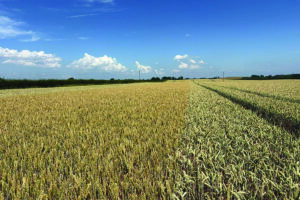
The main challenge came from exceptionally dry weather. Only 72mm of rain fell between 16 March and mid-July, compared with the farm’s normal monthly rainfall of 50-60mm.
The conditions resulted in its earliest harvest on record. Sparkler was the last of the four wheat varieties to be cut, on 16 July. It yielded 8.3t/ha and beat the farm’s next-best winter wheat by about 0.5t/ha.
“Of the four varieties we grew, Sparkler never looked the best variety at any stage,” said Mr Sheardown. “However, at the weighbridge, where it really counts, it delivered on the old adage of ‘looks for show, yield for dough’.”
The crop received 220kg/ha of nitrogen in two applications during March and April. Like Mr Dalton, Mr Sheardown says he will certainly grow the variety again.
Disease challenge
Results were less clear-cut for Herefordshire farmer Ruth Gilder, but Sparkler remained competitive during a difficult season. She grew 12.6ha near Ledbury as a first wheat following turnip seed. It was drilled on 25 September into medium Grade 2 loam.
Alongside drought pressure, crops faced barley yellow dwarf virus after the farm entered a Sustainable Farming Incentive option that prevented insecticide use.
Ms Gilder reported no BYDV symptoms in Sparkler. The crop also stood well and required no T3 fungicide. Harvested on 21 July, it averaged 7.14t/ha. That was in line with, or slightly ahead of, three other wheat varieties grown on the farm.
“Sparkler showed great resilience in overcoming both yellow rust and BYDV, making it one of our cleanest crops. It coped better with the dry conditions than most of our other wheats and was consequently one of our last crops to be cut.”



Crushed farmer urges rethink on farm safety
News Oct 1, 2026

Drought could last another six months
News Sep 28, 2026

Veteran paddlers launch £10,000 YANA challenge
News Aug 27, 2026


Poignant hi-vis reminder on farm safety
News Jul 31, 2026
