

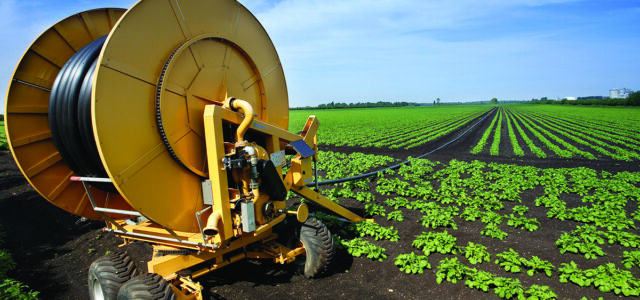
Potato growers may need to rethink irrigation as climate change exposes a growing gap between having enough water and being able to apply it quickly enough, says an independent expert.
A potato crop can use 6-7mm of water a day during prolonged dry weather, according to potato consultant Mark Stalham. That could require 25mm every four days rather than the traditional weekly irrigation cycle.
For some businesses, existing equipment cannot keep pace. Summer 2026 exposed shortcomings in irrigation capacity, storage and field infrastructure. More frequent droughts could also influence rotations, variety choice and the area of irrigated potatoes grown.
“An inch or 25mm of water is now required every four days,” said Dr Stalham. “That’s pretty astounding when growers realise that they can’t irrigate their whole crop every seven days, let alone every four.”
Delivery pressure
The challenge is particularly acute on light sandy soils. At around 32°C, Dr Stalham estimates there may be only 12mm of readily available water before potatoes begin to experience stress. That could mean irrigating every two days to maximise yield. For businesses designed around a seven-day rotation, this presents an obvious capacity problem.
An abstraction licence or reservoir does not ensure sufficient water reaches crops at the optimum time if pumping and application capacity are inadequate. Holding water back can also prove counterproductive. Yield potential may already have been compromised before stored water is applied.
“If you’ve got water, use it when the crop actually needs it and you’ll get the biggest yield response. That means applying water when the crop first comes under stress, and then again when it needs it, rather than preserving water for a theoretical ‘rainy day’.” Irrigation equipment and storage also represent substantial fixed costs, so unused capacity can undermine returns.
“If you’ve got a licence, pump it,” said Dr Stalham. “Pump it somewhere. Give it to your neighbour. Move it from one stream to another. Put it in a reservoir. If you’re not using it, somebody or another industry will come and take it away.” A farm may therefore have sufficient water on paper, but that means little if equipment cannot deliver the required volume during peak demand.
 System economics
Drip irrigation can deliver water precisely, but Dr Stalham cautioned against treating it as a universal answer. Drip operates at relatively low pressure and volume, so existing high-pressure systems may require redesign. Pump efficiency can suffer when pressure is reduced substantially, while installation carries significant fixed costs. So do evaporative losses.
“On a 29°C day, it is estimated that evaporative losses from sprinklers are at around 5%. In hotter conditions such as 37-38°C, with moderate wind, the potential loss is between 12 and 18%, but losses from large-nozzle rain guns are <10%. This highlights the importance of understanding the irrigation system, the crop, the soil and the economics as a whole, rather than just focusing on the technology.”
Early-season timing is equally important. Dr Stalham describes the first irrigation applications as crucial to building the crop’s “solar panel”. Rapid canopy development increases light interception and drives tuber production.
“In a typical maincrop situation, two irrigation doses separated by around 7–10 days can help take ground cover from roughly 30% to 70–80%, then towards full canopy. But once that canopy has been built, the water requirement does not disappear. It increases because the crop now has a large evaporative surface to maintain.”
Rainfall during early June was therefore particularly valuable in 2026. Some 30-70mm fell across much of the UK during the first 10 days, helping crops establish their canopy and reducing the immediate need for irrigation.
Establishment race
A hotter, potentially shorter effective growing season also puts greater value on rapid establishment. Bright conditions allow potatoes to accumulate yield quickly when water is available, but crops have less time to recover when growth is interrupted.
That has implications for planting dates, variety selection, crop protection and harvest planning. Longer-season indeterminate varieties may continue rooting and exploit later rainfall. However, that does not automatically translate into greater yield.
“Longer-season types may have greater opportunity to continue rooting and potentially capture later rainfall, but that does not mean they automatically convert access to water into yield. They remain dependent on adequate water supply if their yield potential is to be realised and stress avoided.”
 BASF business development manager Paul Goddard said agronomy should encourage rapid and even establishment. “For both determinate and indeterminate varieties, we’ve seen real benefits from using the Xemium-based Allstar in-furrow – it gets the crop off to a good start.” He said emergence was more than a week earlier than other in-furrow treatments in some seasons. “A week of light interception in June is worth three weeks in September.”
Water stress can also complicate disease management. Drought-stressed plants may become more vulnerable to some pathogens, while very dry conditions can suppress other diseases. Physiological stress, nutrient deficiencies and disease can also produce overlapping symptoms, making careful diagnosis important.
For growers planning future potato enterprises, water volume, abstraction rights, storage and application capacity must increasingly be considered alongside soils, varieties and crop establishment.
Planning solely around historic weekly water requirements may leave businesses exposed during periods of intense demand. “Growers cannot necessarily rely on the historical assumption that rainfall will arrive when a crop needs it, said Dr Stalham. “We need to consider and adapt strategies now, so we are prepared for future seasons. Four of the last eight years have seen crops impacted by weather stress. It is no longer a question of ‘what if we have a dry season’, but more ‘when’.”



Crushed farmer urges rethink on farm safety
News Oct 1, 2026

Drought could last another six months
News Sep 28, 2026

Veteran paddlers launch £10,000 YANA challenge
News Aug 27, 2026


Poignant hi-vis reminder on farm safety
News Jul 31, 2026
