


Correct pH improves fertiliser returns
Farmers could improve potato quality and fertiliser efficiency by correcting soil pH before planting – challenging long-standing advice that liming ahead of the crop should generally be avoided.
Maintaining optimum pH is increasingly important as growers spend more on crop nutrition, says independent potato agronomist John Sarup. Trials suggest some lime products could reduce common scab rather than increase its incidence.
“Lime is extremely important,” says Mr Sarup. “We’re now spending an increasing amount of money on fertiliser, so we have to make sure we are maximising its nutrient efficiency, and one way is to make sure pH is optimal.”
Changing advice
Growers have been discouraged from applying lime immediately before potatoes because of concerns it could increase common scab. The 2021 edition of the RB209 nutrient management guide recommends no lime unless soil pH is very low. But trials carried out by British Sugar between 2012 and 2015 – and repeated in 2024 – found reductions of up to 50% in scabbed tubers following applications of its LimeX soil conditioner.
Mr Sarup says several growers he advises use LimeX primarily to correct pH and improve nutrient availability. “But they are also seeing a better skin finish and quality generally.” Moisture management remains the main defence against common scab. Growers should maintain adequate moisture around developing tubers for up to six weeks after tuber initiation.
“We’ve seen enough data to know that liming can help,” says Mr Sarup. Common scab levels have been lower than expected on his clients’ farms this season despite the dry summer. Mr Sarup believes extremely dry conditions around tuber initiation could have restricted movement of Streptomyces scabiei, the bacterium responsible for the disease. 
Calcium role
Where common scab has occurred, Mr Sarup says it has tended to affect processing crops where irrigation was not targeted closely enough at tuber initiation.
British Sugar LimeX business manager Glenn Carlisle says the product’s fine particle size makes calcium rapidly available in the root zone. Each tonne supplies more than 250kg of elemental calcium. Calcium plays an important role in strengthening plant cell walls and could therefore help crops defend themselves against infection.
“When growing a scab-susceptible variety, such as Maris Piper, making sure the plant has an abundance of available calcium in the soil will help with common scab control,” says Mr Carlisle, “as the plant will transport calcium to areas infected by the bacteria to help the plant defend itself by strengthening cell walls.”
This response may explain the association between calcium and scab. Higher calcium concentrations around infected areas was interpreted as evidence that calcium increased disease, rather than being part of the plant’s defence. 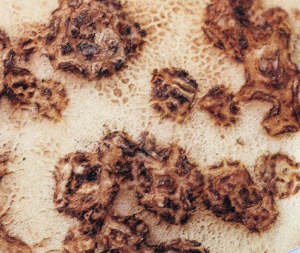
Trial results
British Sugar’s 2024 trials tested LimeX at 7.5t/ha and 10t/ha on Maris Piper potatoes, with treated strips separated by a 12m untreated buffer. The 10t/ha treatment produced a 50% reduction in scab incidence compared with untreated potatoes.
Mr Carlisle says those findings mirrored three earlier years of trials in which LimeX applications also reduced scab. The potential value extends beyond disease management, he adds.
“LimeX will also help reduce calcium deficiency symptoms, like internal rust spot, as well as supplying a large proportion of the crop’s requirements for nutrients such as phosphate and magnesium.”
The preferred approach is to spread after ploughing but before planting, followed by incorporation, says Mr Carlisle. But it is better to apply when there is access to the field, rather than holding off for ideal conditions, he adds.



Sugar beet deal sets £28.50/t fixed price
News Nov 18, 2026

Company directors face liability for fly-tipping
News Nov 18, 2026

Budget ‘misses chance to revive farm investment’
News Nov 18, 2026

Crushed farmer urges rethink on farm safety
News Oct 1, 2026

Drought could last another six months
News Sep 28, 2026

Veteran paddlers launch £10,000 YANA challenge
News Aug 27, 2026