

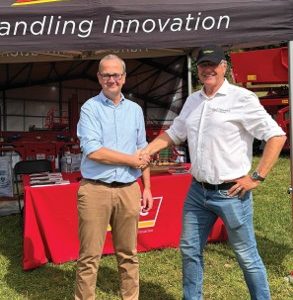
Partnership targets labour saving
Root crop handling experts Tong Engineering have expanded their partnership with Dutch optical sorting specialist Flikweert Vision as growers seek to reduce labour requirements in potato and onion grading.
Tong will now represent the company’s agricultural sorting equipment across southern England and Wales. The agreement covers sales, system integration, installation, commissioning and aftersales support.
The two companies have not disclosed investment costs or detailed performance figures for the UK installations. But follows the doubling of labour efficiency on a UK farm where an optical sorter was introduced – suggesting huge savings.
Labour pressure
The companies are targeting growing interest in automated post-harvest handling as businesses seek to improve throughput and reduce their reliance on manual crop grading.
Flikweert Vision develops camera-based optical sorting systems specifically for potatoes and onions. The equipment identifies defects and grades crops automatically. Tong will integrate the technology into its grading and handling lines, combining the sorter with crop intake, outfeed equipment and control systems.
Simon Lee, sales director at Tong Engineering, said growers were increasingly considering optical sorting as part of investment in grading facilities. “We’re seeing increasing demand from customers looking to introduce optical sorting into their grading operations.”
Mr Lee said integrating the technology within a wider handling system could improve its performance. “While the technology delivers significant benefits as a standalone machine, its full potential is realised when it is engineered into a complete grading and handling line.”
System integration
The partnership reflects a wider move towards automation where packers and growers face pressure to control labour costs while maintaining grading standards. Optical systems can reduce the amount of manual inspection required, although their performance also depends on crops being presented consistently to the cameras.
Tong says matching the infeed, sorter and outfeed equipment should help maintain crop flow while reducing bottlenecks through the grading line. The expanded agreement also gives Flikweert Vision a UK partner able to provide local installation and technical support.
Martijn Flikweert, managing director of Flikweert Vision, said the arrangement should make it easier for growers to incorporate optical sorting into complete grading lines. “By ensuring the Flikweert Vision sorter is well matched with the infeed, outfeed and controls of the overall line, customers can get the most from their sorting process.”
Mr Flikweert said growers would also have local access to advice, commissioning and servicing. For businesses considering investment, the commercial case is likely to rest on the balance between capital cost, labour savings and increased grading capacity. But the reported doubling of labour efficiency indicates the potential savings as automation becomes more widely adopted in post-harvest handling.



Sugar beet deal sets £28.50/t fixed price
News Nov 18, 2026

Company directors face liability for fly-tipping
News Nov 18, 2026

Budget ‘misses chance to revive farm investment’
News Nov 18, 2026

Crushed farmer urges rethink on farm safety
News Oct 1, 2026

Drought could last another six months
News Sep 28, 2026

Veteran paddlers launch £10,000 YANA challenge
News Aug 27, 2026