

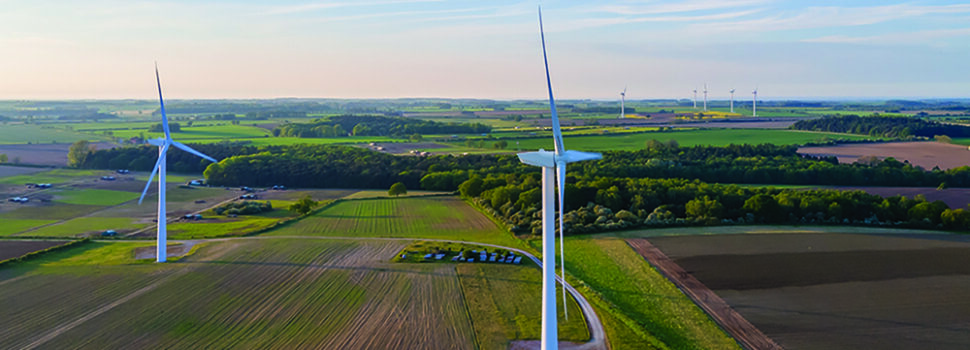
Leasing farmland for wind turbines can generate useful revenue – but it is important to avoid some common pitfalls.
More landowners are exploring onshore wind turbines as a diversification option – encouraged by renewed government support for domestic renewable energy production.
Wind turbines on farmland represent a promising opportunity, with strong financial returns making the idea of ‘leasing a field for wind power’ appealing. But many farmers can quickly feel overwhelmed by the challenges involved.
Fortunately, help is at hand when assessing site suitability, planning permission, timescales, the need to secure an equitable return, fair contracts and choosing the right development partner with the necessary level of expertise.
Available support
Many landowners have no clear benchmark for what their land is worth to the wind sector. But this is vital to make offers comparable, reveal the true value of a site and generate the clarity and confidence needed to make informed decisions. Suitable wind sites in the UK are in higher demand than ever.
The government’s wider net zero and clean-energy initiatives and targets support a fast-tracked, large-scale expansion of onshore wind, doubling by 2030, and that is only possible if enough land is made available. From the outset, landowners must find out whether their land is suitable for wind development. This requires a detailed assessment of meteorological, geographical, technical, infrastructural and planning considerations.
Even in regions where rules have been eased or supportive local policies are in place, the proximity of residential properties, environmental designations, aviation constraints and radar safeguarding can turn entire corridors into formal exclusion zones.
Investigating all these factors manually is laborious and often comes with significant costs. Traditional approaches involve site visits, wind measurements, multiple assessments and a wide range of studies. This process once took weeks or even months. But assessment tools are available to speed up the process – mapping restrictions from the outset, enabling landowners to see clearly where development is feasible.
If land shows strong potential, the next question is how to engage with developers. Again, digital platforms play an increasingly important role. Land identified as promising can be listed on an online marketplace used by reputable developers.
Development partner
Once a pre-analysed and screened site is confirmed as viable, a good adviser will match it with a qualified project developer in a transparent process, saving resources while increasing project visibility.
This shifts the advantage to landowners. High-quality sites attract strong demand, resulting in more competitive lease terms, and genuine choice between prospective development partners.”
Genuine competition between developers typically results in significantly higher leasing rates. A wind turbine with a tip height of 140-160m, for example, will quite comfortably generate more power with a higher potential income stream.
But leasing farmland for wind energy is never a purely bilateral arrangement between landowner and the developer. It is also important to consider neighbouring landowners, the parish or local authority and the wider community.
In some cases, wind-opposition groups or environmental organisations will sometimes mobilise resistance on behalf of those nearby – even if they are not directly affected themselves.
Early, open and consistent communication helps build trust, reduce conflict and foster cooperation, whether that is about visual impact, property values or construction impacts. Good relations with the local planning authority are particularly important, as planning decisions, access rights and infrastructure coordination depend heavily on them.
Local businesses may also be involved, providing services or participating in environmental mitigation, and communities can benefit directly through community benefit funds, including local electricity discount schemes.
Financial resilience
Leasing farmland for a wind project is therefore far from an everyday decision, but the potential rewards are substantial, with a reliable long-term income that strengthens the financial resilience of a farming business.
The energy transition offers landowners a rare opportunity to actively shape the future of their businesses, while unlocking new income streams.
With political conditions now firmly aligned and digital platforms bringing transparency and efficiency to the market, this is an especially favourable moment to consider marketing suitable land. Those who engage early with the opportunities and challenges stand to benefit from stronger competition and more attractive terms – while also making a meaningful contribution to the sustainable energy supply of their region.
Hans-Georg von Lewinski is head of international development for onshore wind project partner Caeli.