

 A former machinery shed on a Suffolk farm is now generating an income after being converted into a padel court.
Widely seen as the latest craze for social sports, padel is a mix of tennis and squash – played on an enclosed 20m x 10m court with solid bats and pressurised balls which rebound off glass walls. Easy to learn, it is fun but challenging too.
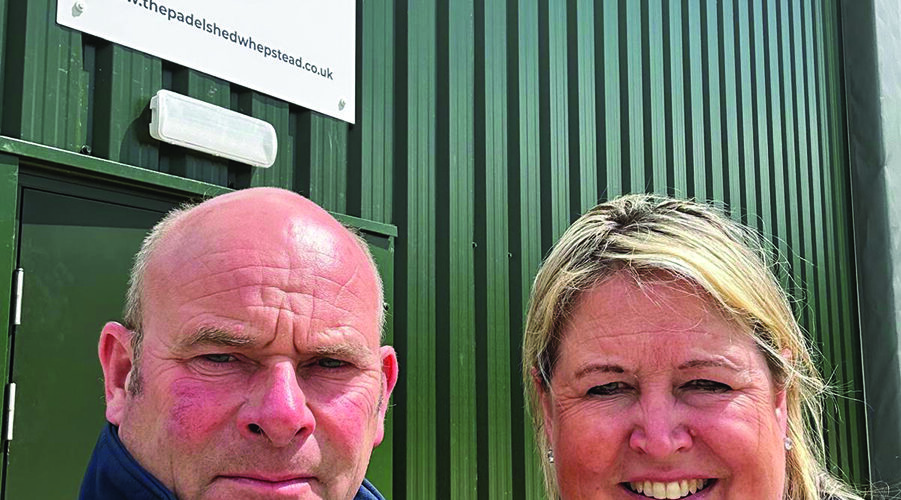
The Padel Shed is at Hall Farm, Whepstead, near Bury St Edmunds. It is run by Andrew, Sarah and Henry Maddever – a single-court, pay-and-play venue that brings players onto the family’s 1,850ha arable farm from morning until late evening.
R H Maddever Farms is a multi-generation arable enterprise, operating across owned, rented and contract-farmed land. The family grow wheat, spring barley, spring oats, sugar beet, oilseed rape, peas, beans and maize for local anaerobic digestion plants. But with margins under pressure, rising input costs and dwindling grant support, the family has been looking for ways to strengthen business resilience, says Andrew.
Natural fit
“It’s no secret that margins are under pressure and it’s difficult making a sensible return We’ve been steadily diversifying for several years and were looking for a new venture to complement the business. Padel seemed like a natural fit.”
Digital booking apps allow players to find courts, join games and be matched with others of similar ability using a rating system like a golf handicap.
This accessibility is driving the UK’s padel boom. New figures from the sport’s governing body, the Lawn Tennis Association, show the sport has reached 1 million participants –up from 15,000 in 2019 – with 1,825 courts across the country.
The sport is well-suited to farms, owing to its relatively small footprint, ability to use repurposed spaces and digital links tapping into rural populations looking for accessible leisure spots.
The Maddevers already had experience of diversification, with industrial units, and self-storage added to the farm business over the past decade. Beyond additional income, padel offered something different for the family.
“It creates a bit more interest in the business. It’s easy to become blinkered to growing wheat year after year. It’s amazing what comes out of conversations with people who never normally interact with farming.”
With Hall Farm being three miles from Bury St Edmunds, a town with a growing population, padel also felt more suitable than options such as weddings or events, given the farm’s village setting.
“We’ve often thought about marquees and weddings, but we’re in the middle of a village with houses around, so we’re always conscious of noise,” says Andrew.
The family applied for Class R permitted development for the change of use, with a 56-day prior approval process, Andrew describes the process as straightforward:
“There were no objections. The local authority, parish council and residents were all very keen. It ticked every box in terms of health, leisure and local amenities.”
Even so, noise was taken seriously. “We did noise surveys beforehand, but the reports all suggested it would be fine,” he says. “It turns out the noise from padel isn’t really the game, it’s the players.”
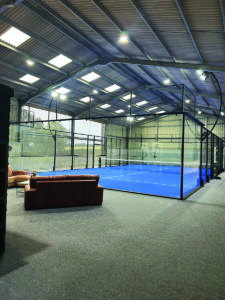
At 30m x 15m, the former machinery shed was a good fit, giving enough room for a 20m x 10m padel court, toilets and a lounge. Height is also an important consideration for prospective courts and as the eaves on stand around 5.5m, it worked well. The long side of the shed had originally been open. During conversion, two bays were closed to leave an 18m opening. On the enclosed side, the family opened up a 12m section to make the most of the view.
Scenic
“It’s quite scenic on that side, so we wanted to capitalise on that,” explains Andrew.
Much of the foundation and utility work was done by the farm team. The family invested in a high-spec fit-out, adding carpeting, quality lighting, a lounge area, picnic benches, and equipment hire. Complimentary water, and an honesty-bar for coffee and snacks, using QR code payments, complete the offer.
The court was supplied by Spain’s SG Padel and installed in two days.
“There was about four tonnes of glass on one pallet; moving that was a nervy moment,” says Andrew.
The Padel Shed operates as a pay-and-play facility through the Padel Mates app. Sarah researched what other venues were using locally before choosing a system that could handle bookings, payments and customer data.
“It works very well and gives you all the stats you need,” she says. “Bookings peak from lunchtime to 10pm and many customers only book a couple of hours ahead.”
Andrew sees the private, single-court experience and the rural location as the venue’s unique selling points. “We’re not in a big warehouse or a tennis club, so we offer something different. A lot of the comments we get are that it’s a beautiful setting, and it’s your own private space for as long as you book it.”
Weatherproof
Unpredictable UK weather has a direct impact on padel venues. Industry estimates suggest outdoor courts can lose 30%–50% of annual playing time due to weather. Crosswinds can affect ball flight, while fluctuating temperatures, rain and moisture on the glass or playing surfaces change how the ball reacts, ultimately impacting customer experience
With around 55% of UK padel courts still uncovered, according to Savills, protecting courts from the elements is a key challenge. The same research notes that weather-related issues are influencing investment decisions, prompting a shift towards indoor and partially covered courts among operators looking to maximise bookings and complementary income through food, drink and events.
The practical challenge for the Maddevers was covering an 18m x 5m opening on their new venue, originally designed for machinery access.
“We needed some way of protecting the shed from the elements, but we wanted to maintain the view and ventilation,” recalls Andrew
The family turned to Galebreaker after Sarah, a former grain trader, saw the company’s screens being used on a commercial grain store. The site installed two motorised Multi-Bay Screens, covering openings of 18m x 5m and 12m x 5m in a high-performance mesh to reduce wind and rain.
Outdoor environment
The screens have mostly stayed down because they still allow visibility and airflow. The result is what Andrew describes as the best of an indoor court in what feels like an outdoor environment.
“They give such good visibility; people still get the view. We’ve had a lot of compliments about having the fresh air without the wind. You stand inside behind the screen and you can barely feel a breeze. It’s so much better than I thought it was going to be.”
Will Johnson, UK & Ireland Sales Manager at Galebreaker, says more agricultural customers are exploring padel for existing buildings.
“Farmers are starting with the same questions they would ask about protecting livestock or grain buildings: how do we control airflow, protect against weather, keep light in the space and make the building work commercially?” he says. “With padel, the court needs to feel open and well ventilated, but still be protected from crosswinds, driving rain and moisture. The right screening keeps the court comfortable and playable, ensuring it pays its way across more of the year.”
Not hands-off
Despite app-based bookings, Andrew and Sarah say the venue still needs pro-active management. They meet first-time users, explain the facilities, restock refreshments and monitor security. The venue opens at 7am, with the last booking at 9pm and play finishing at 10pm.
“It’s a commitment,” says Sarah. “You have to be there seven days a week to open in the morning and close and turn everything off at night.”
“It’s not as full on as a farm shop and restaurant but it’s as involved as we want it to be,” agrees Andrew. “I wouldn’t want it to be entirely hands-off. People like that bit of interaction and it breaks up my routine. My advice, if you’re going to do it, is go all in; finishing touches make the difference. It’s lovely to hear the ‘wows’ as people walk in.”